Thursday, 19 April 2012

Acknowledgements

litekimchi. (2006, Jan 30). Walk around chinatown [Online forum comment]. Retrieved from http://www.virtualtourist.com/travel/Asia/Singapore/Singapore-1495679/Things_To_Do-Singapore-Chinatown_Niu_Che_Shui-BR-3.html
jlanza29. (2011, March 25). Same as in other countries !!!! [Online forum comment]. Retrieved from http://www.virtualtourist.com/travel/Asia/Singapore/Singapore-1495679/Things_To_Do-Singapore-Chinatown_Niu_Che_Shui-BR-1.html
ChinaTown Hotel, Singapore. (n.d.). History of chinatown. Retrieved from http://www.chinatownhotel.com/chinatown_history.html
Cornelius-Takahama, Vernon. (30, May 2000).Chinatown. Retrieved from http://infopedia.nl.sg/articles/SIP_734_2005-01-24.html

Lowe-Ismail, Geraldene. (2011). chinatown memories. Singapore: Tailsman Pubs.
Brown, Edwin A. (2007). indiscreet memories : 1901 singapore through the eyes of a colonial englishman. Singapore: Monsoon Books.

Conclusion

In conclusion, Chinatown’s distinct culture is somewhat more vague and less prominent as compared to when it was developed in the 1900s. People, especially the younger generation, sees it as a tourism spot that only tourists would be interested in visiting, and not a place where they would be able to truly understand their roots and culture, weakening their sense of belonging to their own culture. To the older generation, the culture is diminishing, despite the similar preserved buildings, and only a few still view it as a common space for them to interact with one another. However, it still is successful in giving the notion of “uniquely Singapore”, with the place surrounded by modern high-rise buildings, giving a mix of cultures.
The government should be credited for attempting to preserve the prominent culture, as can be seen in the preservation of physical structures, but lack of content in keeping the town rooted to tradition defeats the purpose of ensuring a good preservation that is comfortable for use of common space for tourists and locals alike. 

Suggestions

Based on what was observed, recommendations for government measures to be taken should be centred on bringing the authenticity of Chinese culture back into Chinatown. I recommend that Chinatown be themed around ensuring that Chinese cultural roots are kept strong, and not too commercialized from the tourism sector. Regulations could be developed to ensure that the number of tourism shops do not override the ones who truly showcases to tourists and locals alike the authentic Chinese culture. As Chinatown is still also a tourist attraction, a balance between economical interests and culture preservation could be found, through the balance of a feasible number of tourist-centred attractions and Chinese culture related shops. To keep to the identity of Chinatown being a common space for Chinese locals, areas such as the verandahs and open spaces for old folks to interact could be expanded, such that this place appeals to tourists and locals alike. The portrayal of Chinatown should be seen as a cultural area, instead of a tourist destination, such that the social identity and initial idea of Sir Stamford Raffles could be kept the same despite modernization efforts that are inevitable. 

Public Opinion

Singaporean Auntie, who lives in the Ang Mo Kio area: She was there to buy Chinese goodies and products, but commented that it is indeed not the Chinatown that it used to be. She picked an example of how one would expect purely Indian products sold at Little India, Malay products at Geylang Serai, and comments that instead of that, she sees commercialized shops such as the famous Koi bubble tea, and many other shops that do not sell Chinese products. She states that to her, “there are a lot of nonsense”, such as an overwhelming stores selling handphone covers and keychains, that would not appeal to people like her who go to Chinatown specially for the supposed Chinese products that it is supposed to sell.

Tourist, from Australia: She was there to experience the Chinese culture in Chinatown, and states that she is pleased with showcase of culture through the physical structures of shophouses, and the array of food which displays the Chinese ethnicity prominently. However, she too, felt that there are stores which are not related to culture at all, such as the sales of “branded” perfumes and bags along the street. In all, she is pleased that she is able to feel the culture through traditional shops and buildings, but feel that some are too modernized and unrelated to the culture.

User “litekimchi” from virtualtourist.com: “Unfortunately, Chinatown has become a tourist trap, especially the market streets (Pagoda, Smith, Trengganu and Smith). But you can still catch glimpses in small mom-and-pop stores around.”
User “jlanza29”, from virtualtourist.com: “Well, I have been to several Chinatown's around the world in various countries and I'm really not a big fan of them, there all the same (except the one in Bangkok)(read my Bangkok travel pages) and the same goes for the Chinatown here in Singapore......Cheap souvenirs and cheap food abound, don't get me wrong if you have never exprienced a Chinatown anywhere in the world then come to the one here in Singapore and you'll experince what I'm talking about and if you ever go to a city with a Chinatown you'll see that there all the same, but I come to Chinatown looking for the odd souvenir's or odd art work and believe me you'll find it !!!!! HIGHLY RECOMMEND it, if you never been in one, if you been in one, SKIP it....and do something else with your time, your not missing much !!!!!”

Change in Common Space and Identity

Through the rapid modernization and renovations that Chinatown has undergone, the government has taken measures to preserve the culture, while ensuring that it is not left the messy state that it was in the past. However, I feel that the preservation of the Chinese culture is done in a rather forced manner, meant for tourism purposes rather than being a place in which Chinese can shop and interact with one another in a way that stays true to our roots. It is less intended for the purpose ensuring a common space amongst Chinese, but more of a place of interaction between Chinese locals and foreigners.


This is shown in how the shops are mostly taken over by the tourism industry, such as souvenir shops and camera shops, sometimes even including strange music studios and shops such as the one shown below and the TinTin shop.
This is a vast contrast in the intention of the government to preserve the Chinese culture, showing that Chinatown is heading towards a more commercialized area, where culture is purposefully and sometimes falsely presented to tourists. There is an overload of shops selling items that are more relatable to Singapore history, rather than authentic Chinese goods. It also includes Coin and Mint shops, and a National Heritage Centre. However, this can be seen as a way to include a common space for foreigners and locals, such that they are able to interact through the balance between modernization and old culture. This promotes tourism in the area, but does not seem to be an attempt to ensure that it still remains a common space for Chinese to interact.
True common spaces meant for Chinese locals are now reduced to small spaces within Chinatown, such as this small area for old Chinese folks to play a game of chess or admire the birds, or the verandah on the bridge, where Chinese locals sit and talk with their fellow counterparts. These allows for Chinese locals from all walks of life coming together in these physical structures and share their commonality of traditions and activities. This is also present in the little traditional shops along the street that still provides for the needs of Chinese, such as herbal shops and Chinese goodies, though similarly, this is too a small number compared to shops targeted at tourism.


It is apparent that the Chinatown area has been renovated in the interests of capturing tourists for a walk back in history, as well as to show and present a Chinese culture. This however, might not be very appealing for locals, as the overwhelming number of tourism shops, selling souvenirs that are not relevant to locals. The initial idea of the common space in Chinatown by Sir Stamford Raffles is diminishing, with shops selling authentic Chinese products reduced to a few number, and a vast majority of “I LOVE SINGAPORE” shops.
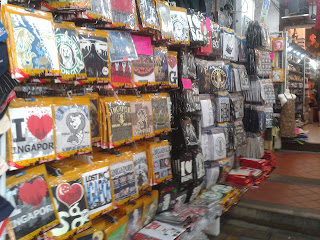
One of the many shops selling Singapore souvenirs, drifting away from the whole theme of Chinatown and Chinese  culture. 

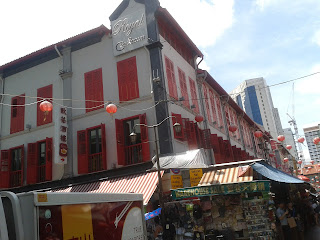
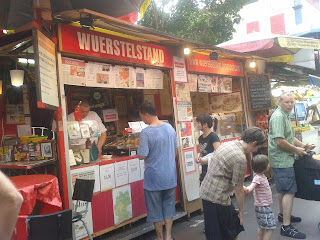
The idea of preservation that encompasses the government’s intention of keeping the physical structure of Chinatown the same through the familiar old shophouses kept the same for the past years, bringing about a rustic and “back-in-time” feeling, is not in line with the actual non-physical ideology. This can be seen below, with how the old, worn-out buildings of the at the top contrasts with the shop content, which is greatly modernized and designed with a modern touch, contradicting the intent of keeping Chinatown the original Chinese ways that it used to be. This is also seen in how stores that are not related to Chinese culture, like the TinTin shop seen, and the German food shop shown below, showing the distant between preservation of culture and the actual way it is. 

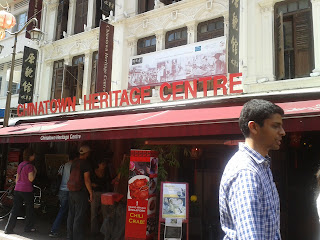
The National Heritage Centre is also placed in the heart of Chinatown, which makes it more appealing for tourists. This can be in a way seen as an effort to produce common space, and forcing interaction between foreign tourists and locals, by ensuring that the foreigners have to enter the centre in which locals interact, providing a common space between locals and foreigners. However, if placed in the context of maintaining it as a place for locals, it would not be applicable in my opinion, since it is a museum for tourists to visit and see the culture in a modernized way of heritage centres, and not preserving the street the way it was. 
However, the government should be credited in keeping Chinatown themed around the original idea of Chinese culture, as said earlier with the preservation of physical structures. It has also allowed for a display of Chinese food products especially, seen in the traditional shops selling Chinese delicacies, such as Si Chuan food stores, dumplings, soups, which allows for an identity of Chinese culture to be kept, and a common space for Chinese locals to purchase the traditional dishes. Despite this, the boundaries and content of Chinatown is not clear, as explained above, with the modernized stores and souvenir shops targeted more at the tourism sector, as well as the intergration of other religions, such as the Indian temple just beyond the streets of Chinatown. 


Wednesday, 18 April 2012

Common Space in Chinatown

Common space is an area in which people are forced to mix, through commonalities found amongst them. It is not necessarily physical, though we shall be looking at how Chinatown allows for the development of common spaces, especially as a platform for Chinese to interact.
Following Sir Stamford Raffles’ initial plan for Chinatown to be an area of stay and interaction amongst Chinese traders and businessmen, Chinatown today still preserves his intention of keeping it rooted to the Chinese culture in which the town was developed and established for in the first place. This can be shown physically, through the physical structures that are preserved. The government has kept the whole notion of giving a physical common space that Chinese can still enter and relate to, even after renovations, such as the preserving of verandahs and old shophouses. This allows for Chinese to enter the physical common space and interact with one another, providing a platform for culture to be maintained and not lost. This is however, greatly limited, as even though the overall structure of old shophouses and verandahs are kept the same, the shops that occupy them are very much different from the initial intentions of staying rooted to Chinese culture. This will be explained later in greater detail.

Identity of Chinatown

Identity is the general overall character of a particular place and culture, in this case Chinatown and its Chinese culture. Naturally, Chinatown has an identity of being a cultural area of the Chinese traditions. It is assumed that it is a place where Chinese locals are able to stay connected through their culture and roots, whether through religion (temples), or cultural delicacies and products that stays authentic to the Chinese culture. It is also assumed that it still serves the purpose of allowing for a Chinese settlement to gather. However, this common assumption of identity of Chinatown, whether it is Singapore or the United States of America, is vastly changed in the Singapore context, due to the rapid modernization of Singapore in the past 40 years. It is today less like a common space for Chinese to gather and stay rooted to their tradition through religion and products, as I will be explaining later. 

Background Knowledge of Chinatown

Chinatown (Singapore) is located in the Outram area in Singapore. It was started up by Sir Stamford Raffles, who envisioned the Chinese to make up the majority of locals in Singapore, therefore allocating the west area of the Singapore River for a Chinese settlement. Singapore then attracted many immigrants from China, and this enlarged the area of the vibrant town. It became the home of many Chinese immigrants, with visiting traders seeking accommodation, eventually settling down too.
The houses were planned to have a uniformed front, a verandah of a certain depth. This led to the creation of the famous five-foot way in the shophouses that are still preserved.
Chinatown is a place where our forefathers first called home. Chinatown has been renovated recently, though some old transitions are still preserved. This is especially so during Chinese New Year, where it is often busy with festive goods.
The old structure of the shophouses that are still maintained and kept through the renovations. 
Shophouses lining the streets, selling various goods.