Through the rapid modernization and renovations that Chinatown has undergone, the government has taken measures to preserve the culture, while ensuring that it is not left the messy state that it was in the past. However, I feel that the preservation of the Chinese culture is done in a rather forced manner, meant for tourism purposes rather than being a place in which Chinese can shop and interact with one another in a way that stays true to our roots. It is less intended for the purpose ensuring a common space amongst Chinese, but more of a place of interaction between Chinese locals and foreigners.


This is shown in how the shops are mostly taken over by the tourism industry, such as souvenir shops and camera shops, sometimes even including strange music studios and shops such as the one shown below and the TinTin shop.
This is a vast contrast in the intention of the government to preserve the Chinese culture, showing that Chinatown is heading towards a more commercialized area, where culture is purposefully and sometimes falsely presented to tourists. There is an overload of shops selling items that are more relatable to Singapore history, rather than authentic Chinese goods. It also includes Coin and Mint shops, and a National Heritage Centre. However, this can be seen as a way to include a common space for foreigners and locals, such that they are able to interact through the balance between modernization and old culture. This promotes tourism in the area, but does not seem to be an attempt to ensure that it still remains a common space for Chinese to interact.
True common spaces meant for Chinese locals are now reduced to small spaces within Chinatown, such as this small area for old Chinese folks to play a game of chess or admire the birds, or the verandah on the bridge, where Chinese locals sit and talk with their fellow counterparts. These allows for Chinese locals from all walks of life coming together in these physical structures and share their commonality of traditions and activities. This is also present in the little traditional shops along the street that still provides for the needs of Chinese, such as herbal shops and Chinese goodies, though similarly, this is too a small number compared to shops targeted at tourism.
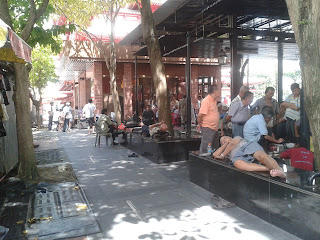
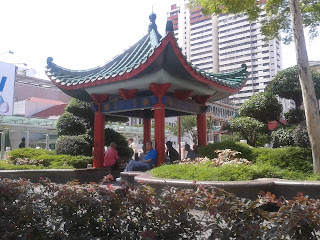


It is apparent that the Chinatown area has been renovated in the interests of capturing tourists for a walk back in history, as well as to show and present a Chinese culture. This however, might not be very appealing for locals, as the overwhelming number of tourism shops, selling souvenirs that are not relevant to locals. The initial idea of the common space in Chinatown by Sir Stamford Raffles is diminishing, with shops selling authentic Chinese products reduced to a few number, and a vast majority of “I LOVE SINGAPORE” shops.
 |
| One of the many shops selling Singapore souvenirs, drifting away from the whole theme of Chinatown and Chinese culture. |
The idea of preservation that encompasses the government’s intention of keeping the physical structure of Chinatown the same through the familiar old shophouses kept the same for the past years, bringing about a rustic and “back-in-time” feeling, is not in line with the actual non-physical ideology. This can be seen below, with how the old, worn-out buildings of the at the top contrasts with the shop content, which is greatly modernized and designed with a modern touch, contradicting the intent of keeping Chinatown the original Chinese ways that it used to be. This is also seen in how stores that are not related to Chinese culture, like the TinTin shop seen, and the German food shop shown below, showing the distant between preservation of culture and the actual way it is.


The National Heritage Centre is also placed in the heart of Chinatown, which makes it more appealing for tourists. This can be in a way seen as an effort to produce common space, and forcing interaction between foreign tourists and locals, by ensuring that the foreigners have to enter the centre in which locals interact, providing a common space between locals and foreigners. However, if placed in the context of maintaining it as a place for locals, it would not be applicable in my opinion, since it is a museum for tourists to visit and see the culture in a modernized way of heritage centres, and not preserving the street the way it was.

However, the government should be credited in keeping Chinatown themed around the original idea of Chinese culture, as said earlier with the preservation of physical structures. It has also allowed for a display of Chinese food products especially, seen in the traditional shops selling Chinese delicacies, such as Si Chuan food stores, dumplings, soups, which allows for an identity of Chinese culture to be kept, and a common space for Chinese locals to purchase the traditional dishes. Despite this, the boundaries and content of Chinatown is not clear, as explained above, with the modernized stores and souvenir shops targeted more at the tourism sector, as well as the intergration of other religions, such as the Indian temple just beyond the streets of Chinatown.


No comments:
Post a Comment